Construction Project Manager: Data Centers and Mission-Critical
This is the shortest path from white-collar to blue-collar prosperity. If you have project management experience, a legal background, or financial oversight skills, you are already most of the way there.
This module is special. Of every career path in this course, data center construction project management is the one where your existing white-collar skills translate most directly, most immediately, and most lucratively. Read this one carefully.
Why This Path Is Different
Every other module in this course asks you to set aside a significant piece of who you are professionally and learn something genuinely new from the ground up. The electrician has to master the NEC. The ironworker has to build calluses and overcome fear of heights. The plumber has to learn every fitting and code by heart.
Site coordination is the core skill of a data center construction PM
This module is different. As a construction project manager at a data center contractor, your existing skills are not just useful, they are the whole point. Contract management, change order negotiation, budget oversight, stakeholder communication, schedule pressure, risk mitigation, and team coordination: these are the job. The construction site is the new context. Your skills are the currency.
That is not to say it is easy or that you can walk in without preparation. You still need to earn credibility on the job site, understand enough about MEP systems to manage the people building them, and get comfortable in a hard hat. But the learning curve is dramatically shorter than any other transition in this course, and the payoff at the top of that curve is exceptional.
$142,303
Average at Prime Data Centers (54% above general PM average)
$200K+
Total comp at senior level with 17% average bonus
92%
Of contractors unable to fill open PM positions
$1T
Annual data center infrastructure spend projected by 2030
Drone surveys are now standard for large-scale data center site management
The Money: What You Can Actually Earn
Let's be direct about the numbers because they matter and they are genuinely exciting.
The national average for a general construction project manager sits at $89,385. That is a decent living, but it is not the number we are here to talk about. The moment you specialize in data centers and mission-critical construction, the floor rises substantially.
Role Level
Base Salary
With Bonus (avg 17%)
General Construction PM (national avg)
$89,385
~$104,500
Data Center CPM, Mid-Level
$107,643
~$126,000
Data Center CPM, Senior/Expert
$137,341
~$160,700
Prime Data Centers Average
$142,303
~$166,500
Top-Tier Senior DC PM
$175,000 to $225,000
$200,000 to $260,000
Those top-tier numbers are real. They are not outliers reserved for people with thirty years in the trades. They reflect what the market will pay for someone who can manage a $200 million data center build on schedule for a hyperscaler that is counting every day of delay in millions of dollars of lost compute capacity.
The bonus structure is worth noting separately. At 17% of base on average, a $175,000 salary becomes a $205,000 check. Project bonuses at major contractors for on-time, under-budget delivery can push total comp even higher. This is not software startup options that might be worth something someday. This is cash, delivered at project completion, because you delivered the building that the client needed.
The Demand: Why Right Now Is the Moment
You have probably heard the phrase "AI is driving demand for data centers." That is true, but the scale of what is happening in construction right now is something most people outside the industry do not fully appreciate.
Global data center capital expenditure increased 57% in 2025 alone. Not 5.7%. Fifty-seven percent. That is a single-year acceleration that construction labor markets simply cannot absorb. The pipeline of new facilities planned through 2030 is staggering, with some analysts projecting $1 trillion in annual data center infrastructure spending by the end of the decade.
The result? The contractors building these facilities are desperate for experienced project managers. Not someday. Right now.
439,000 new construction workers are needed in 2025 alone
92% of contractors report they cannot fill open positions
52% say staffing shortages are actively causing business disruptions
The data center construction market is $200 billion and growing faster than any other segment of commercial construction
When 92% of the employers in your target industry cannot find enough qualified people, that is not just a job market. That is a negotiating position. That is the ability to choose your employer, your geography, your projects, and largely your compensation. That context matters when you are thinking about making this transition.
From r/ConstructionManagers: A commercial PM who had been managing office construction at $95k posted about making the move to a data center contractor. Within 90 days of targeted job applications, he landed at $145k. He said the hardest part was convincing himself it was real before he applied. The technical learning curve, he reported, was manageable. The pay raise was immediate.
What You Actually Do: The Data Center CPM Role
Let's ground this in specifics. What does a data center construction project manager actually spend their days doing?
Data centers are among the most complex construction projects in the commercial sector. A typical hyperscale facility involves electrical infrastructure capable of delivering tens or hundreds of megawatts of power, precision cooling systems that maintain exact temperature and humidity within narrow tolerances, raised floor systems with cable management routing thousands of network and power circuits, backup generator systems with days of fuel capacity, fire suppression systems with precise response requirements, and security infrastructure that often exceeds what you would find at a government facility.
Managing the build means coordinating electrical contractors, mechanical contractors, plumbing contractors, structural steel erectors, concrete subcontractors, specialty commissioning teams, network infrastructure crews, and the owner's technical representatives. Dozens of subcontractors, hundreds of workers, millions of square feet of interconnected systems, all converging on a commissioning date that the client's engineering team has been counting down to for two years.
The PM is the person who holds all of that together. That means contract management, RFI coordination, change order negotiation, schedule maintenance, safety oversight, budget tracking, stakeholder communication, and problem-solving when (not if) things go sideways. Sound familiar? It should. If you have managed a complex software launch, a corporate transaction, a large financial audit, or a major operational initiative, you have already done most of this work. The domain knowledge is different. The skill set is the same.
Your White-Collar Background: The Honest Translation
Let's talk specifically about where different professional backgrounds fit, because this is not a one-size-fits-all answer.
Lawyers and Legal Professionals
This is the single most direct transition in the entire course. Construction is one of the most contract-intensive industries in existence. Change orders, differing site conditions clauses, liquidated damages provisions, subcontractor default situations, bond claims, lien rights: the legal and contractual dimension of a large construction project is enormous.
Most construction PMs learn contract management on the job, by making expensive mistakes. You walk in already knowing how to read a contract, identify risk allocation provisions, negotiate from a position of understanding, and document everything properly for a potential dispute. That is not a minor advantage. Contractors will pay significantly more for a PM who does not need three years of hard knocks to understand the contractual side of the job.
Practical path: Get your PMP, add OSHA 30, start applying. Your legal background is the differentiator that gets you interviews at data center specialty contractors. Be direct about it in your resume and cover letters.
Finance and Operations Managers
Budget management at scale, forecasting, variance analysis, and stakeholder reporting: you have been doing the financial side of project management for years. Construction project financials are different in their specifics (pay applications, schedule of values, retainage, certified payroll) but the underlying discipline of tracking money, projecting costs, and communicating financial status to executives is identical.
Operations managers bring an additional layer: the ability to see systems, identify bottlenecks, and think about sequencing and resource allocation. A data center build is a massive logistics puzzle. Your instinct for operational efficiency translates directly to the job site.
Practical path: PMP is your first credential because it formalizes the PM methodology you already practice informally. Add OSHA 30 and one data center specific certification (Uptime Institute ATD or CDCP) to signal specialization. Your financial modeling skills will make you unusually credible in cost management conversations.
Software Engineering Managers
Managing a team of engineers under constant schedule pressure, handling scope creep, communicating technical complexity to non-technical stakeholders, and delivering working systems against hard deadlines: you have been doing construction project management already. The metaphors are almost perfectly aligned.
SWE managers understand something that many traditional construction PMs do not: the client's perspective from the inside. When you are managing a build for Microsoft or Google or Amazon, you understand exactly what is at stake for the team on the other side of that call. You know how they think about latency, compute capacity, and the cost of a delayed commissioning date. That empathy and that shared language is worth real money in client relationships.
Additionally, the construction industry is deeply underinvested in technology. Your instinct for tooling, automation, and data will make you exceptional at using platforms like Procore, Autodesk Construction Cloud, and the emerging AI-based project management tools that are beginning to reshape how large builds are managed. You are not just a good PM in this role. You are a PM who can help drag the industry forward.
Practical path: Lean into the tech client relationship angle. Get PMP and OSHA 30. Consider the Uptime Institute ATD because it teaches you the language of data center infrastructure that you will be managing. Your technical credibility is a genuine differentiator, not just a talking point.
Marketing and Operations Managers with Budget Authority
If you have managed large marketing budgets, coordinated agency relationships, managed product launches with hard external deadlines, or overseen operational rollouts across multiple locations, you have more relevant experience than you might think.
The PM role is fundamentally about coordination, communication, and accountability. You are used to managing people who do not report to you directly, meeting hard external deadlines, and explaining complex status to executives. That is the job description.
What you will need to develop: a deeper fluency in construction-specific concepts like CPM scheduling, MEP coordination, and quality control documentation. The PMP helps here. So does spending time on actual job sites before you are running them, even if that means starting in an assistant PM or owner's representative role.
The Training Path: Shortest Route to the Job
Here is where this module earns its reputation as the fastest transition in the course. The core credentials you need are:
1
Project Management Professional (PMP)
The PMP from PMI is the gold standard general PM credential. Study time: 3 to 6 months depending on your current PM experience. Exam cost: $405 to $555 depending on PMI membership. If you already have significant PM experience, this is mostly a matter of formalizing what you already know and learning the PMI terminology. Many experienced managers pass with focused prep over a single dedicated month.
2
OSHA 30-Hour Construction
Non-negotiable for anyone on a construction site in a supervisory role. This is 30 hours of safety training, available online or in person. Cost: $150 to $300. Timeline: complete in a week if you are motivated. This credential signals that you take safety seriously, and in an industry where safety incidents carry enormous legal and financial consequences, that signal matters.
3
Data Center Specific Certification (Pick One)
The Uptime Institute Accredited Tier Designer (ATD) credential teaches you the Tier classification system that governs data center design requirements. Cost: $3,000 to $5,000. Alternatively, the CDCP (Certified Data Center Professional) provides a solid foundational credential. For network-heavy roles, the BICSI RCDD ($800 to $1,200) covers data center cabling and connectivity infrastructure. You do not need all of these. Pick the one that best matches the specific contractor and client type you are targeting.
4
Procore and Autodesk Familiarity
Both platforms have free learning resources and certification tracks. Getting familiar with the tools of the trade before your first interview demonstrates initiative and removes a potential objection. Neither takes more than a few days to get comfortable with at a basic level.
Total investment for a PM or operations professional with existing credentials: 6 to 12 months and $3,000 to $10,000. Compare that to the $40,000 to $80,000 and 2 to 4 years required for most other trades transitions in this course, and you understand why we call this the shortest path.
Note: The Construction Manager in charge (CCM) credential via CMAA requires 8 years of relevant experience, so it is a later-career credential rather than an entry point. It is worth knowing about for long-term professional development, but it is not a prerequisite for landing your first data center PM role.
A Day in the Life
6:30 AM
RFI Review and Daily Log
Start the day working through the overnight RFI (Request for Information) queue in Procore. Subcontractors and site superintendents have been flagging questions about drawings, specifications, and scope interpretations. Some get resolved immediately with a simple clarification. Others require a call to the engineer of record or a change order discussion. You document everything.
7:30 AM
Subcontractor Coordination Meeting
The daily or weekly coordination meeting is the heartbeat of the project. Six to twelve subcontractor PMs and supers gather (in person or by video) to review schedule, flag conflicts, coordinate sequencing, and surface problems before they become crises. You run this meeting. Your job is to keep it focused, document commitments, and make sure everyone leaves with clear action items.
9:00 AM
Site Walk
Hard hat on. You walk the site with your superintendent. You are not inspecting craft work (that is the QC manager's job) but you are watching the overall flow of work, spotting coordination problems before they become schedule impacts, and maintaining visibility with the crews. Being present on the site is how you earn credibility with the people who actually build the building.
11:00 AM
Change Order Negotiations
Every complex project generates changes. An engineer revises a drawing. The owner adds scope. A differing site condition is encountered. Each one needs to be priced, negotiated, documented, and either approved or disputed. Your ability to understand contract language, evaluate reasonable cost claims, and negotiate fair resolutions without damaging subcontractor relationships is one of the highest-value skills you bring to this role.
1:00 PM
Schedule Update in Procore
The project schedule is a living document. You update predecessor and successor relationships based on actual progress, identify critical path impacts, and prepare the weekly lookahead schedule that tells the field what needs to happen over the next three weeks to stay on track.
2:30 PM
Safety Incident Report Review
Any incidents from the previous 24 hours get reviewed. Near misses, first aids, and any equipment issues. Safety is not a compliance exercise. On a large build with hundreds of workers, safety failures cascade into OSHA investigations, project shutdowns, insurance claims, and reputational damage that follows a contractor for years. You take this part of the job seriously.
3:30 PM
Client Stakeholder Call
The tech client (a hyperscaler, a colocation operator, or an enterprise with its own DC program) has a technical team watching this project like a hawk. You give them a status update, address their questions, and manage their concerns. These calls are where your ability to communicate complex technical status clearly and confidently earns its full value. The client measures delay in compute capacity. They are counting on you.
5:00 PM
Punch List Review
As sections of the project near completion, punch list management becomes a major focus. Hundreds or thousands of items that need to be corrected before the owner accepts the work. You coordinate the tracking, assignment, and verification of completion for each item. Systematic, documented, relentless.
The AI and Technology Connection
Let's be direct about why this market exists and why it will continue to grow for at least a decade.
Every model that runs a large language model, every request processed by a recommendation engine, every video streamed to a mobile device, and every autonomous vehicle making real-time navigation decisions requires physical infrastructure: servers, power, cooling, networking. That infrastructure lives in data centers. And the AI moment we are living through has created a demand for new data center capacity that is unlike anything the industry has seen before.
The hyperscalers (Amazon, Microsoft, Google, Meta) are each spending tens of billions per quarter on data center construction. The colocation operators (Equinix, Digital Realty, Iron Mountain) are expanding their portfolios aggressively. Enterprise organizations that previously relied on cloud services are building their own AI infrastructure at scale.
This is not a short-term spike. It is a structural shift in the economy. The data center construction market was already $200 billion before the AI acceleration. It is now growing at rates that the construction industry has never had to absorb. The result is a shortage of experienced construction managers that will persist for years because you cannot train PMs as fast as the market needs them.
The person who positions themselves as a data center construction PM specialist today is positioning themselves in one of the most durable, high-demand, high-compensation construction specialties that will exist for the foreseeable future.
The Skill Set You Already Have
There is a thing that happens when experienced white-collar professionals start researching construction project management. They look at job descriptions, see words like "MEP coordination" and "CPM scheduling" and "commissioning," and think those words represent a wall between them and the job.
They do not. They represent vocabulary. Vocabulary is learned in weeks, not years. The underlying work, which is managing complex systems, coordinating multiple stakeholders toward a shared deadline, controlling costs, and communicating clearly under pressure, is something you have been doing for years. You are not starting from zero. You are translating your existing competence into a new domain where it happens to be in extremely high demand.
The construction PM who understood contracts as a lawyer. The one who built financial models as an operations manager. The one who managed engineering teams through crunch as an SWE manager. These are not hypothetical perfect candidates. They are the candidates that data center contractors are actively, urgently looking for right now.
Getting Started: Your Action Plan
1
Audit Your Existing PM Experience
Before you invest in credentials, take stock of what you already have. PMP eligibility requires 36 months of project management experience (or 60 if you do not have a four-year degree). Most white-collar professionals meet this threshold without realizing it. Document your PM experience now, in PMI's language: initiating, planning, executing, monitoring, and closing.
2
Start PMP Prep
Sign up for a PMP prep course (PrepCast, Joseph Phillips on Udemy, or a live boot camp depending on your learning style). The PMI exam is 180 questions over about 4 hours, a mix of predictive and agile PM scenarios. Most people with PM experience pass with 2 to 3 months of dedicated study. Set a target date and book the exam.
3
Complete OSHA 30
Take the OSHA 30-hour Construction Safety course online. It can be completed in a week of evenings. This is a table-stakes credential for any on-site supervisory role. Do not show up to a data center contractor interview without it.
4
Research the Data Center Contractor Landscape
Know the major players: Turner Construction, DPR Construction, Holder Construction, Balfour Beatty, Swinerton, Mortenson, and the hyperscaler internal construction teams. Look at their LinkedIn pages, their job postings, their project portfolios. Understand what kinds of projects they build and what kinds of PMs they are looking for.
5
Reframe Your Resume
Your resume needs to lead with project management competencies, not just your job titles. Budget managed, stakeholders coordinated, contracts negotiated, teams led, deadlines delivered. Make the translation obvious. Hiring managers at construction contractors are not necessarily fluent in white-collar jargon, so you need to make the connection explicit.
6
Start Applying Before You Feel Ready
This is the lesson from the Reddit story above. The person who waited until they felt perfectly prepared would still be waiting. The market is so hungry for experienced PM talent that a strong white-collar background with PMP in progress can land interviews. Apply early. The interviews themselves will teach you what you need to know. Do not self-select out of opportunities before the market has a chance to tell you yes.
The bottom line: If you are a lawyer, finance professional, operations manager, or SWE manager with 5 or more years of experience, a path to $130,000 to $175,000 in base salary at a data center construction contractor is achievable within 12 to 18 months. The credentials are manageable, the demand is extraordinary, and the skills you already have are exactly what the market needs most.
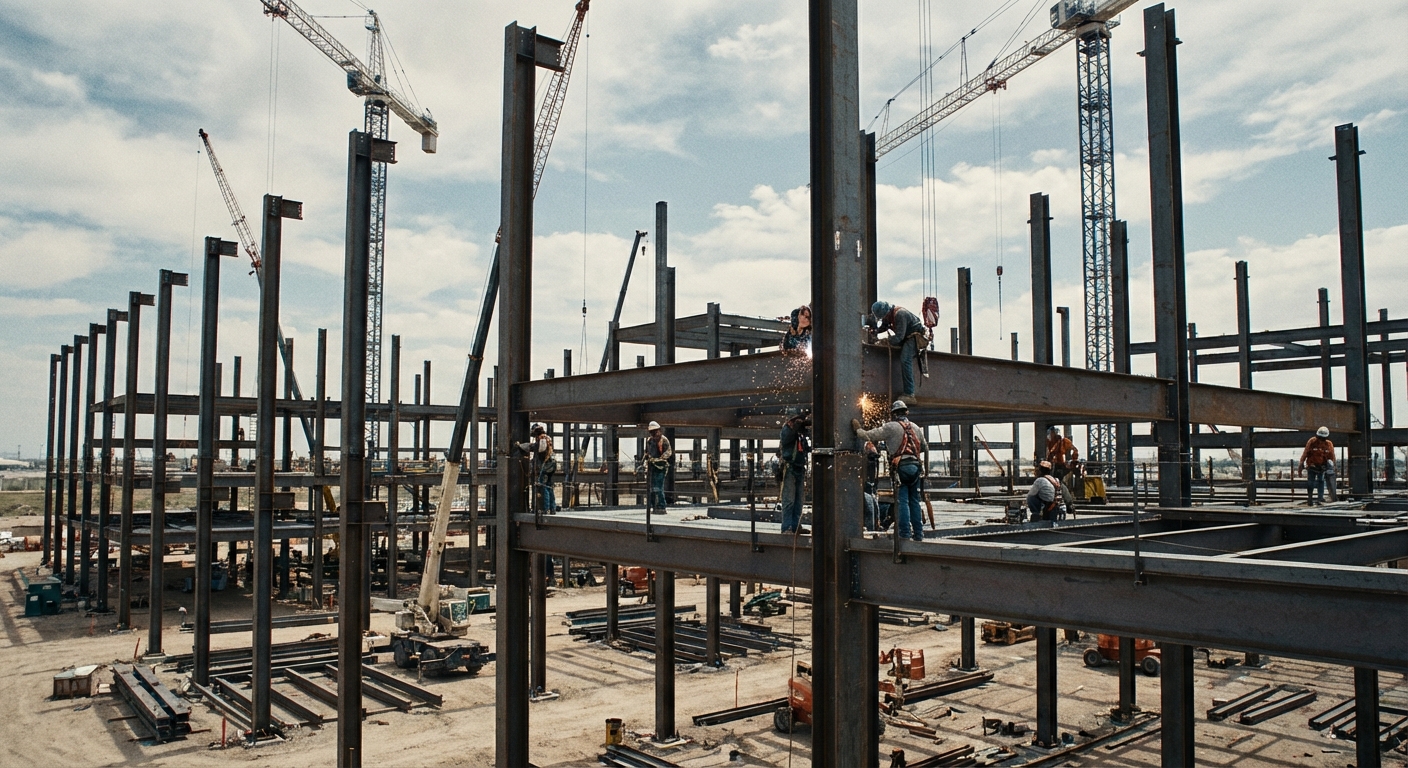
Data center campuses require massive structural steel work from the ground up