Heavy Equipment Operator: Building the Data Center Campus
Before a single server rack is installed, before a single cable is pulled, hundreds of millions of dollars of earthwork has to happen. The people running that equipment are some of the best-paid craft workers in construction, and the data center boom has made them more valuable than ever.
The ground truth: Every data center you have ever heard of started as dirt. Somebody had to move that dirt with precision and speed. That somebody is a heavy equipment operator, and right now there are not nearly enough of them to meet demand.
Where It All Begins
People who work in offices tend to think of construction as the part that happens after a building is already designed. You see the steel going up, the concrete being poured, the exterior taking shape. But the first months of any large construction project happen underground and on the ground, before any of that visible work begins.
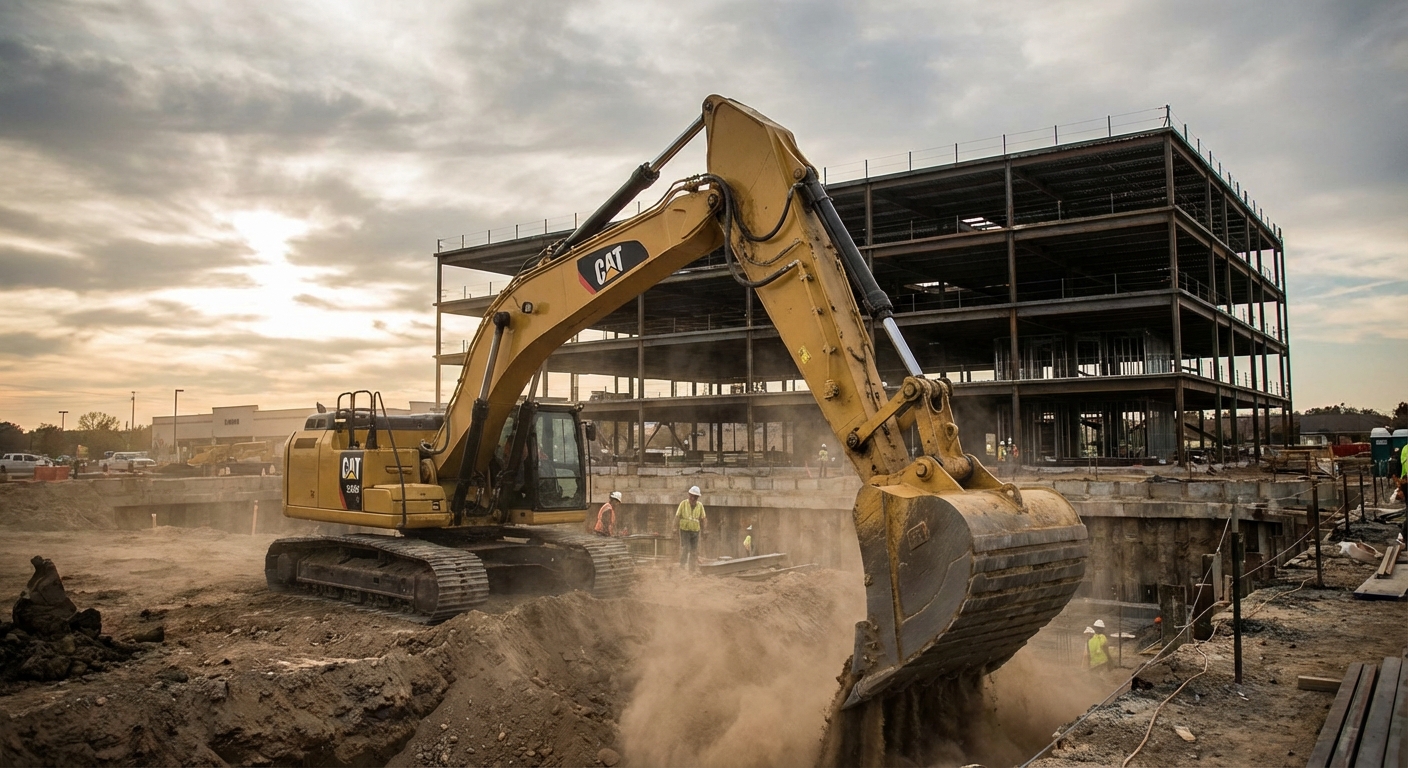
Foundation excavation is the first phase of every data center campus build
For a hyperscale data center campus, that groundwork can be staggering in scale. We are talking about campuses that occupy hundreds of acres. Sites that require millions of cubic yards of earthmoving before the foundation work can even begin. Complex underground utility networks: high-voltage electrical conduit, water and sewer infrastructure, telecommunications pathways, fuel lines for backup generator systems, drainage systems engineered to manage enormous amounts of stormwater. All of it has to be installed in a specific sequence, at precise depths and grades, before anyone starts framing a wall.
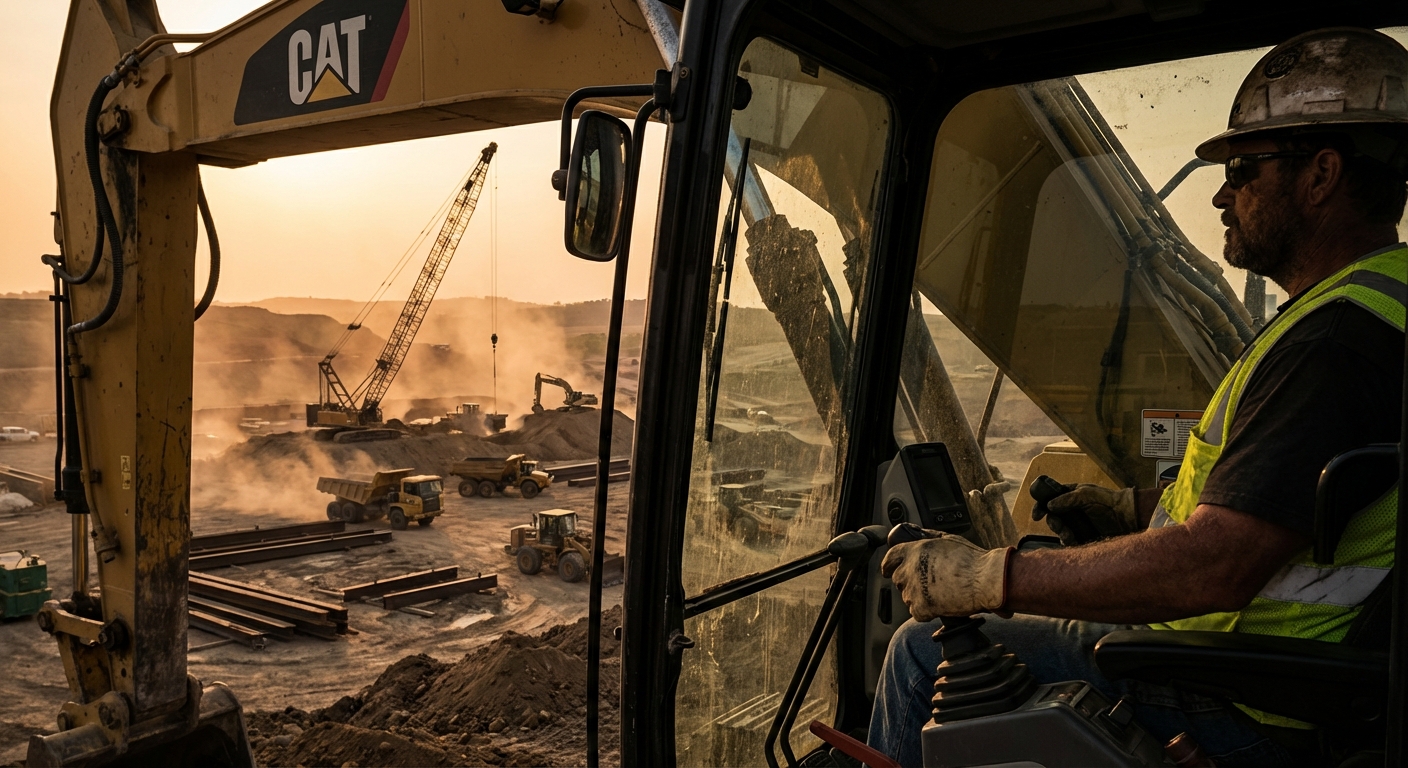
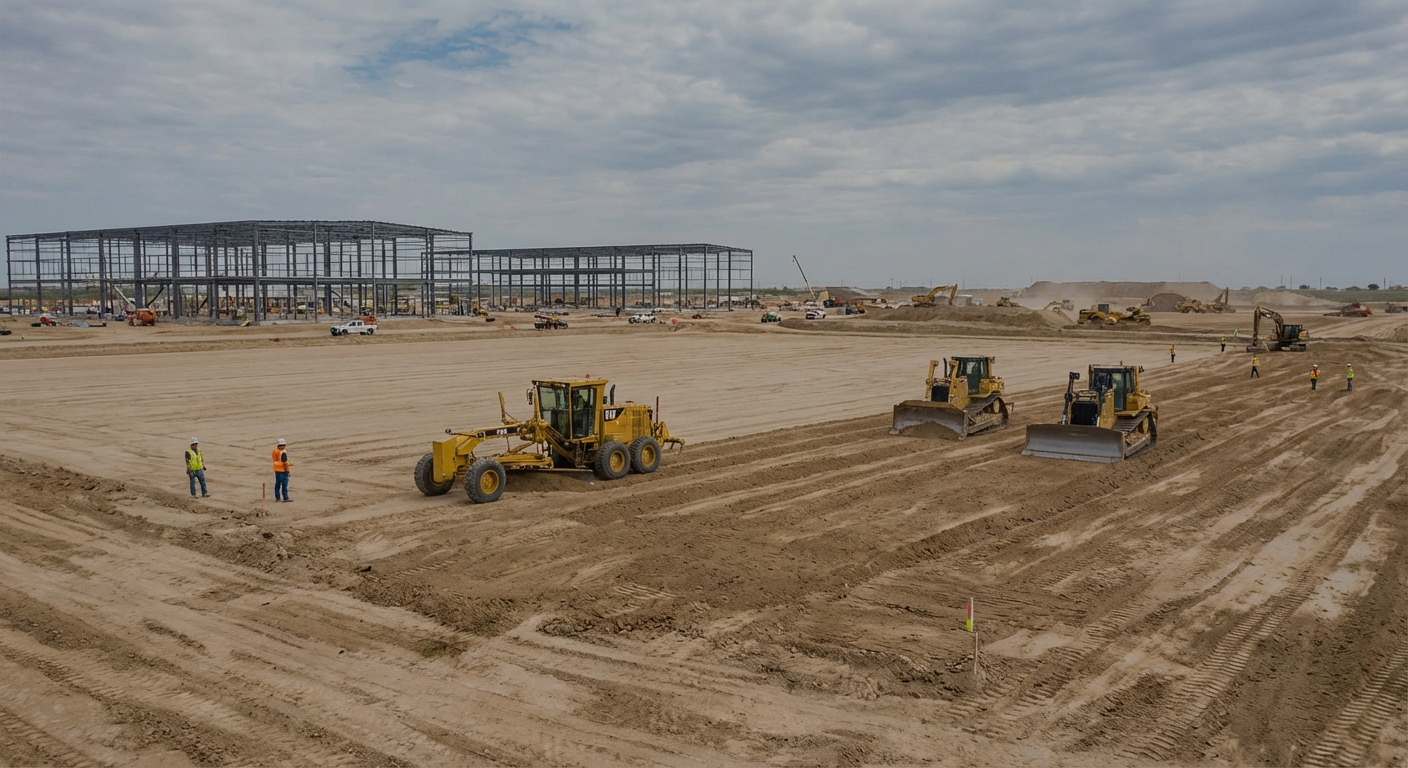
The machines that do this work are some of the most impressive equipment in the construction industry. Excavators that can lift 30 or 40 tons in a single pass. Bulldozers reshaping terrain across hundreds of acres. Motor graders achieving millimeter-level precision across vast flat surfaces. Compactors running overlapping passes to achieve the engineered density requirements that prevent a $200 million building from settling unevenly over time.
The people who operate this equipment are skilled professionals. Not button-pushers. Not just people who happened to sit in a big machine one day. Operators who have spent years developing the muscle memory, spatial awareness, and technical judgment to do this work accurately, efficiently, and safely. And the demand for those operators has never been higher in the industry's history.
$58,320
BLS median wage (May 2024), experienced operators earn significantly more
$99,930+
Crane operators at the top of the earnings scale
46,200
Annual job openings in heavy equipment operation
25-30%
Premium above standard commercial for data center work
Pad grading for data center campuses covers dozens of acres
The Earnings Picture
Let's look at what heavy equipment operators actually earn, because the range is wider than most people realize, and the ceiling is higher than most office workers would guess.
Experience Level
Annual Earnings Range
Entry Level (0 to 2 years)
$39,850 to $46,305
BLS Median (all operators)
$58,320
Experienced (5+ years)
$63,483 to $71,253
Data Center Construction Premium
$65,000 to $90,000
Crane Operators (top earners)
$99,930 and above
A few things worth noting here. First, the entry-level numbers, while lower than some other trades, represent the starting point of a career arc that can reach $90,000 or more within five to seven years. Second, the data center premium is real and persistent: 25 to 30% above what the same operator would earn on standard commercial construction. Third, crane operators represent a separate specialty that requires additional licensing but commands the highest wages in the equipment operating trades, regularly exceeding $100,000 annually in high-cost markets and union jurisdictions.
Union membership significantly affects earnings. The International Union of Operating Engineers (IUOE) negotiates wages, benefits, and working conditions for heavy equipment operators across the country. Union operators in major metros and in specialized applications can earn total compensation packages (wages plus health insurance, pension, annuity) that rival what many white-collar professionals make, especially when you factor in the absence of student loan debt and the earlier career start.
Demand: The Data Center Earthwork Pipeline
BLS projects 4% growth in heavy equipment operator employment from 2024 to 2034. That is respectable, but it does not tell the full story of what is happening in the data center segment specifically.
The hyperscalers are building at a pace that is genuinely unprecedented in the commercial construction industry. When Amazon announces a new data center campus in Virginia, Northern Virginia (the largest data center market in the world), that is typically multiple buildings on a site that might cover 100 to 400 acres. Before a single steel column goes up, the site prep alone can involve six to twelve months of continuous earthwork by a fleet of dozens of machines.
Multiply that by all of the hyperscaler expansion programs running simultaneously, add the colocation operators expanding their own campuses, add the enterprise organizations building AI-dedicated facilities, and you begin to understand why contractors are running 46,200 annual job openings in this trade and still struggling to find enough qualified operators.
The shortfall is not temporary. Training an equipment operator takes years. The IUOE apprenticeship is 3 to 4 years. The NCCER certification pathway is 6 to 12 months for the credential but years of actual proficiency development beyond that. You cannot manufacture a skilled excavator operator in a semester. The mismatch between demand growth and the time required to develop qualified workers is a structural problem that will persist for years.
That is good news for anyone who starts the training pathway now. The people entering the trade today will be approaching peak earning years exactly when the data center construction pipeline is at its most intense.
The AI Connection: Why Every Server Farm Starts With an Excavator
Here is something worth understanding about the physical reality of data centers. When you ask ChatGPT a question, the response comes from a building. A real, physical building on real ground that was prepared by real machines operated by real people. The software magic depends entirely on the physical infrastructure.
What does that infrastructure look like before the building goes up? Let's walk through a realistic hyperscale site:
The site might be a former industrial property, a piece of agricultural land in a rural area with cheap power, or a greenfield parcel in a growing data center corridor. Regardless of starting condition, before construction can begin, the site needs to be cleared, grubbed, and prepared. Trees removed, stumps ground out, topsoil stripped and stockpiled for later restoration.
Then comes the earthwork. The building pad for a large data center needs to be at a precise elevation, perfectly flat within engineering tolerances, and compacted to specified density across its entire footprint. Depending on the site's natural topography, this might mean importing hundreds of thousands of cubic yards of fill material, or it might mean excavating enormous volumes of existing soil that goes off-site. Either way, it is months of continuous equipment operation.
Underground utilities go in next. High-voltage electrical ductbanks (often running at 34.5kV or higher for the incoming utility feed) are trenched in at specific depths and grades. Water and sewer infrastructure. Natural gas lines for generator systems. Communications pathways. Fuel systems. Drainage. Every one of these systems requires precision trenching, careful bedding material installation, and precise compaction of the backfill to protect the installed infrastructure and maintain surface grade.
Foundation systems for massive concrete data center buildings often require deep caisson foundations or driven piles, depending on soil conditions. The equipment fleet on a site like this is enormous: multiple excavators, multiple graders, multiple compactors, scrapers, haul trucks, and specialty equipment for the foundation systems.
And increasingly, all of this work is guided by technology that makes precision not just possible but measurable in real time.
The Technology Revolution in Earthwork
If you are coming from a technical background and the idea of operating heavy equipment sounds like a step backward in terms of technological sophistication, reconsider. Modern earthwork is genuinely high-tech, and operators who understand the technology are commanding premium wages.
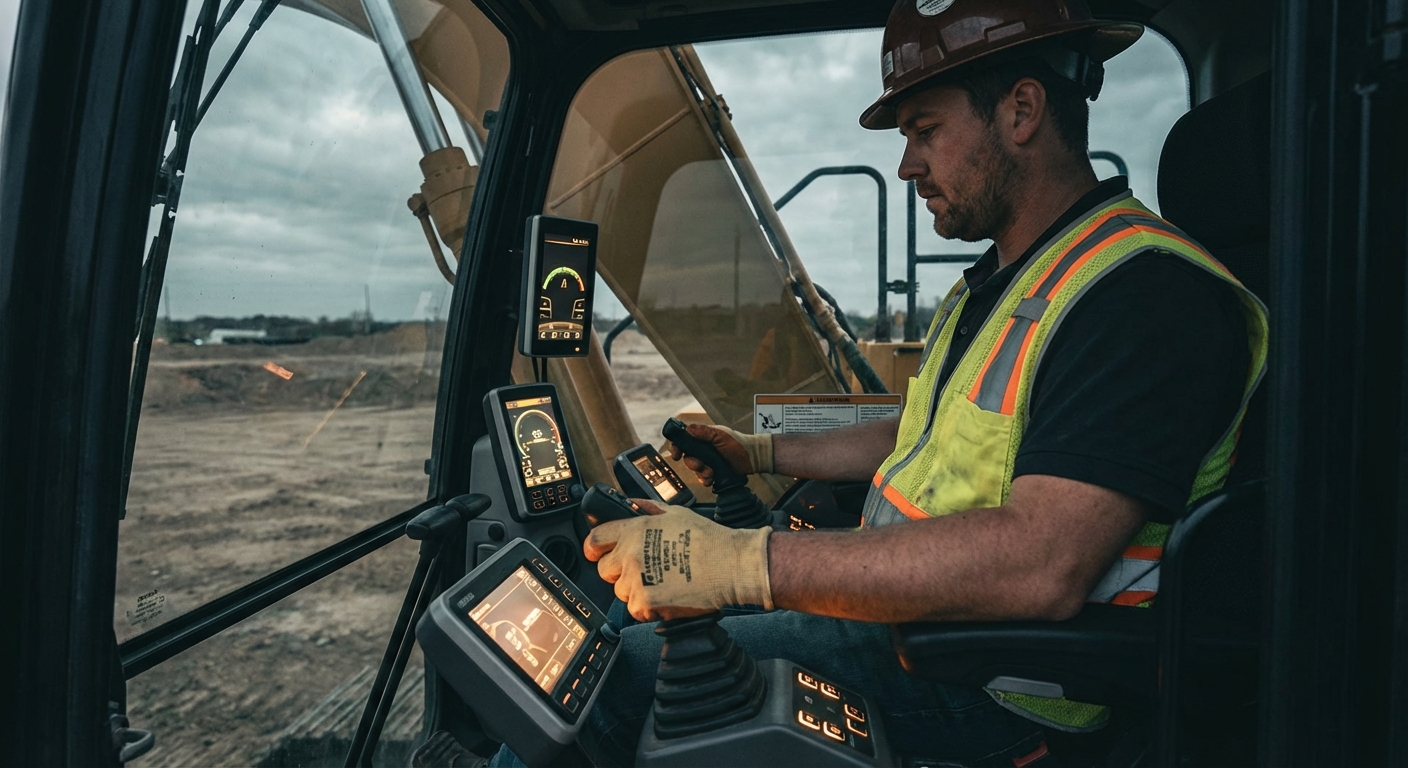
GPS-based machine control systems have fundamentally changed how earthwork precision works. An excavator equipped with a machine control system has GPS antennas on the boom and bucket. The system knows, in real time, exactly where the cutting edge of the bucket is in three-dimensional space, referenced against the digital design model of the finished grade. The operator sees a display showing the difference between where the bucket is and where it should be. Instead of relying entirely on manual staking by surveyors (who can only mark discrete points), the operator can achieve design grade continuously, across the entire machine pass.
The result is faster work with less material waste, fewer survey delays, and measurable precision that can be documented and reported to the owner. On a data center project where the owner is a hyperscaler with engineering teams monitoring every aspect of quality, that documented precision matters.
Beyond machine control, modern equipment is thoroughly instrumented with telematics systems that track fuel consumption, idle time, production rates, diagnostic codes, and maintenance intervals. A fleet of machines operating on a large data center site generates enormous amounts of operational data. The contractors who can analyze that data to optimize equipment utilization are gaining a competitive edge, and the operators who understand what the data means are valuable partners in that process.
Operations and Production Managers
If you have ever managed a production operation, logistics network, or multi-team operational workflow, the mental model you bring to heavy equipment work is more relevant than you might think. Large earthwork operations are, at their core, production management problems. Equipment fleet coordination, shift scheduling, material haul cycle optimization, and bottleneck identification are all production challenges you have encountered in different contexts.
Where this background shines most directly is in the journey from operator to foreman to superintendent. The people who move into field leadership roles fastest are often the ones who have the strongest mental models for sequencing, resource allocation, and production planning. Your operations background does not go away when you climb into the cab. It becomes your path to leadership on the job site.
Financial and Risk Analysts
Here is an angle that sounds unusual but is genuinely compelling: the precision earning premium. Modern GPS machine control and telematics create a world where equipment operation is measurable, documentable, and optimizable in ways that resemble quantitative work more than you might expect.
Operators who consistently achieve design grade on the first pass (rather than requiring multiple passes or over-excavation and re-filling) are directly reducing project cost. That value is visible in the data. Contractors who understand production efficiency at a quantitative level are beginning to reward operators whose telematics data shows exceptional precision and utilization rates. For someone who is comfortable thinking about systems in terms of measurable performance, this is a different kind of professional engagement than most people imagine when they think about running a bulldozer.
Software Engineers and Technical Professionals
This is worth saying clearly: software engineers who become heavy equipment operators are positioned to be the most valuable people in the future of construction technology, and it is not particularly close.
The autonomous heavy equipment revolution is underway. Built Robotics, Teleo, and several other companies are building semi-autonomous and remotely-operated versions of standard construction equipment. The technology exists. The challenge is integrating it into real job site workflows with the reliability and safety that contractors require. The people who will lead that integration are the ones who understand both the technology and the job site, and right now those people essentially do not exist.
An operator who can also read and write code, who understands control systems, who can contribute to the development and deployment of autonomy technology, is not just an equipment operator. They are a bridge between two worlds that desperately need to be connected. That is an extraordinarily rare and valuable position to occupy in an industry worth hundreds of billions of dollars annually.
Even before autonomous systems become mainstream, your technical background makes you the operator who can actually troubleshoot machine control software in the field, interpret telematics data intelligently, and communicate with the engineering teams on the other side of the project. That is worth real money right now.
Training Paths: Getting Your Seat in the Cab
There are several legitimate routes into the operating trades, and the right one depends on your circumstances, timeline, and financial situation.
1
IUOE Apprenticeship (Best Long-Term Value)
The International Union of Operating Engineers offers a 3 to 4 year apprenticeship program that is one of the best deals in the trades. You work while you learn, earning wages from day one (typically 60 to 70% of journeyman scale, rising as you progress). The training is paid for by the union/employer partnership. You graduate as a journeyman operator with full union membership, which means access to union wages, health insurance, and the pension that union contractors are bound by agreement to provide. The catch: you need to get into the program, which involves passing the application process and being dispatched to a contractor. Contact your local IUOE to understand the current wait time and application process.
2
NCCER Heavy Equipment Operator Certification
The National Center for Construction Education and Research (NCCER) offers a structured heavy equipment operator curriculum available through accredited training providers. Completion time: 6 to 12 months for the core certification. Cost: $5,000 to $15,000 depending on program and location. This pathway is faster than the apprenticeship and works well if you want to enter the workforce sooner. The credential is industry-recognized and respected by non-union contractors especially.
3
Trade School or Vocational Program
Dedicated heavy equipment trade schools offer 3 to 9 month programs with hands-on equipment time. Cost: $5,000 to $20,000. These programs typically cover multiple machine types (excavator, bulldozer, motor grader, compactor, loader) and provide certification upon completion. Quality varies significantly between programs. Look for schools that have actual machines for student practice (not just simulators), relationships with local contractors for job placement, and current NCCER accreditation.
4
The Laborer to Operator Pipeline (Costs Nothing)
Many working operators started as general laborers on construction sites, got noticed by equipment operators and superintendents, and were given opportunities to develop their skills over time. This path is slower and depends on being in the right place with the right attitude, but it is worth mentioning because it is genuinely free and it builds relationships in the industry simultaneously. If you need to start generating income quickly and cannot absorb training costs, starting as a laborer on a data center site is a legitimate pathway.
5
Manufacturer Training (CAT, John Deere, Komatsu)
Major equipment manufacturers offer training programs through their dealer networks. Caterpillar's dealer network, for example, offers operator training programs at many locations. These are typically shorter and more equipment-specific than full trade programs, but they can be valuable supplements to other training or as entry points for someone in a geography where apprenticeships have long wait times.
A Day in the Life: Running the Excavator
5:30 AM
Pre-Op Safety Inspection
Before the engine starts, you walk the machine. Walk-around inspection following the manufacturer's checklist: fluid levels, hydraulic lines for leaks, bucket teeth and cutting edge condition, track tension, lights and backup alarm, cab cleanliness, fire extinguisher present. This is not optional and it is not bureaucratic. An excavator that fails mechanically at the wrong moment can injure or kill people. The pre-op inspection is how you stay ahead of those failures.
6:00 AM
Grade Plan Review with Superintendent
Before you move a single bucket of dirt, you review the day's work scope with the site superintendent. What area are you working? What is the target elevation? What utilities are mapped in the area? Any conflicts with other trades? You review the digital design file in the machine control system to confirm it matches the current design revision. On a data center site, the civil engineering is often being updated in real time as the owner's team makes design adjustments. Verifying you have the current file is not paranoia. It is professionalism.
6:30 AM
Clearing and Grubbing Operations
Depending on the phase, the first task might be clearing vegetation and topsoil from an area being opened for the first time. This work requires attention to site boundaries, protection of existing vegetation in areas designated for preservation, and awareness of underground utilities that may be in the area. The machine is powerful enough to destroy things you did not intend to destroy. Precision and awareness are the job.
8:00 AM
Precision Grading with GPS-Guided Bucket
This is the core skill. You are shaping the earth to match a design model, using a combination of the machine control display, your own visual judgment, and a felt sense of what the bucket is doing. Good operators can hold tolerances of a tenth of a foot or better across large areas, consistently, for hours. It is a skill that takes years to develop fully but begins paying dividends much sooner. On a data center pad, precision grading at this stage prevents problems that would otherwise cost tens of thousands of dollars to fix later.
10:00 AM
Trenching for Underground Utilities
Trench work requires a different kind of precision: depth control, consistent trench width, clean trench bottom for bedding installation, and careful attention to utility locate markings. Many data center utility systems run at voltages or pressures where a single contact with the wrong system can be catastrophic. Trench work is where experience shows most clearly and where inexperienced operators make expensive mistakes.
11:30 AM
Survey Coordination
Surveyors set stakes and verify grades throughout the day. You work around them, coordinate with them, and use their feedback to verify your machine control system is accurate (GPS systems need to be calibrated against known reference points). The relationship between operators and surveyors is a constant dialogue. Good operators appreciate good surveyors, and vice versa.
2:00 PM
Compaction Testing Documentation
As compacted areas are completed, the QC team runs compaction tests (typically nuclear density gauge tests or Clegg impact tests). The results get documented against the specification requirements. On a data center project, failing compaction test results mean re-work: remove and replace material, recompact, retest. As the operator who placed that fill, you want to know how your work is testing out. That feedback loop improves your process over time.
3:30 PM
End-of-Day Fuel and Maintenance Log
Fuel the machine for the next shift (or confirm it has been fueled). Log the machine hours, any mechanical issues observed during the day, and fluid levels checked during post-op inspection. On a large site with multiple machines, this documentation flows into the fleet management system that the project's equipment coordinator uses to schedule maintenance and track machine utilization. Your end-of-day log is part of a larger system. Do it right.
The Career Arc: Where This Goes
Entry-level equipment operation is not the destination. It is the beginning of a career path with clear progression:
Operator to lead operator. Lead operator to equipment foreman. Equipment foreman to site superintendent. Site superintendent to project manager (this is where the path merges with the Module 10 track). Some operators go the technical route instead, becoming equipment trainers, machine control specialists, or telematics systems managers. The IUOE journeyman designation, combined with years of experience, also qualifies you for shop steward and union representative roles for those interested in the labor relations side of the industry.
The crane operator specialty is particularly worth mentioning as a long-term goal. Mobile crane operators, tower crane operators, and crawler crane operators are among the best-compensated craft workers in the entire construction industry. Crane work requires additional licensure (NCCCO certification is the standard), additional training, and years of apprenticeship before you can operate independently. But the operators who go through that process often end up earning $90,000 to $130,000 annually in non-union markets and significantly more in union jurisdictions with strong crane work demand.
The AI future of this trade: In 10 years, the operators who will command the highest wages and the most interesting careers will be the ones who grew up understanding both the machine and the software. The person who can operate a 30-ton excavator with precision AND understand the GPS control system at a technical level AND contribute to the development of autonomy systems is not a hypothetical future employee. They are the person the industry will be competing ferociously to hire. If that description fits where you want to go, this is your trade.
Getting Started
1
Contact Your Local IUOE
Find your local IUOE chapter at iuoe.org and ask about the apprenticeship application process, current wait times, and any pre-apprenticeship programs they offer. In high-demand markets, wait times can be short. In others, you may want to consider the trade school route while your application is pending.
2
Research NCCER-Accredited Programs in Your Area
Visit nccer.org to find accredited training providers near you. Compare programs on the basis of equipment available for student practice, instructor credentials, job placement rates, and total cost. If possible, visit the facility before enrolling to see the equipment and speak with current students.
3
Get Your OSHA 10 Construction
Even before you start your equipment training, the OSHA 10 card signals to employers that you take safety seriously. It is available online for around $75 and takes about 10 hours to complete. Many training programs require it anyway. Get it early.
4
Learn the Technology Landscape
Spend some time familiarizing yourself with Trimble, Topcon, and Leica machine control systems (all three make GPS guidance systems widely used in construction). Watch YouTube videos of GPS-guided excavators and graders working. Follow channels dedicated to construction technology. This knowledge base will make you stand out during training and job applications, and it will accelerate your development once you are in the cab.
Modern heavy equipment cabs are climate-controlled with advanced digital controls