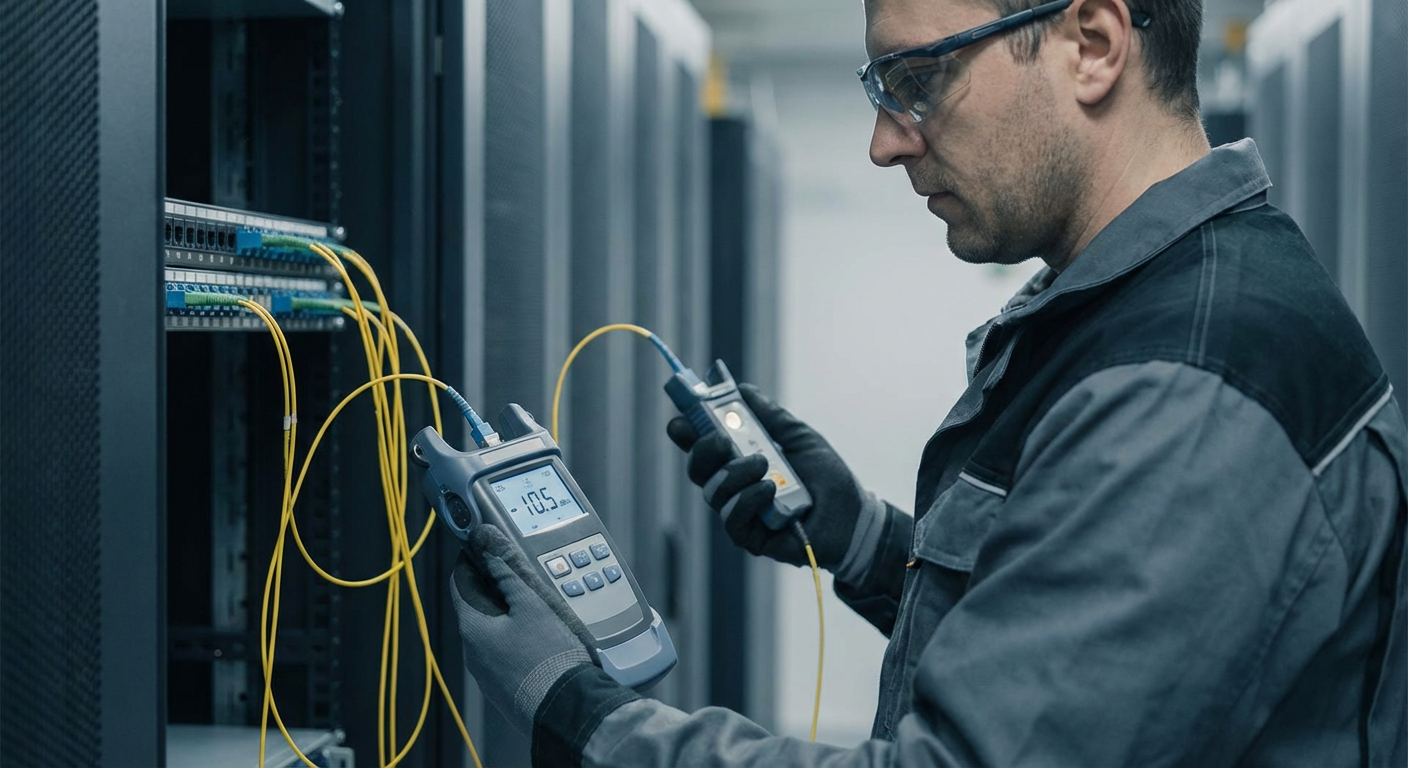
Why Fiber Is the Foundation of Everything AI Does
Think about what it actually takes to train an AI model. Not the abstract concept, but the physical reality. You have thousands of GPUs, each performing billions of calculations per second, that need to communicate with each other constantly, at speeds measured in terabits per second. The data volumes involved are almost incomprehensible: each training step requires moving enormous amounts of information between GPUs, between servers, between racks, between buildings. The entire coordination of a modern AI training cluster depends on moving light, literally light, through glass fibers at the highest possible speeds with the lowest possible latency.
There is no viable alternative. Copper cables cannot carry the bandwidth that modern AI infrastructure requires at scale. Wireless transmission cannot provide the speed, density, or reliability that mission-critical AI infrastructure demands. Fiber optic cables are the only technology that can move information fast enough to connect the thousands of processors that work together when an AI model trains or serves requests.
A single AI training cluster rack requires 36 times more fiber connections than a traditional server rack. Think about that number for a moment. Not 36% more. Thirty-six times more. When a hyperscale company builds a new AI training facility, the fiber infrastructure required is not an afterthought. It is one of the most complex, most expensive, and most demanding aspects of the entire project. And the technicians who can do this work correctly are in short supply.
The United States needs 30,000 fiber optic technicians right now. Not over the next decade. Now. And that number does not even account for the separate, parallel demand created by the $42.5 billion BEAD Program, the federal broadband infrastructure initiative that is funding fiber deployment to rural and underserved communities across the country. This trade has two massive, simultaneous demand drivers pulling in the same direction at the same time.
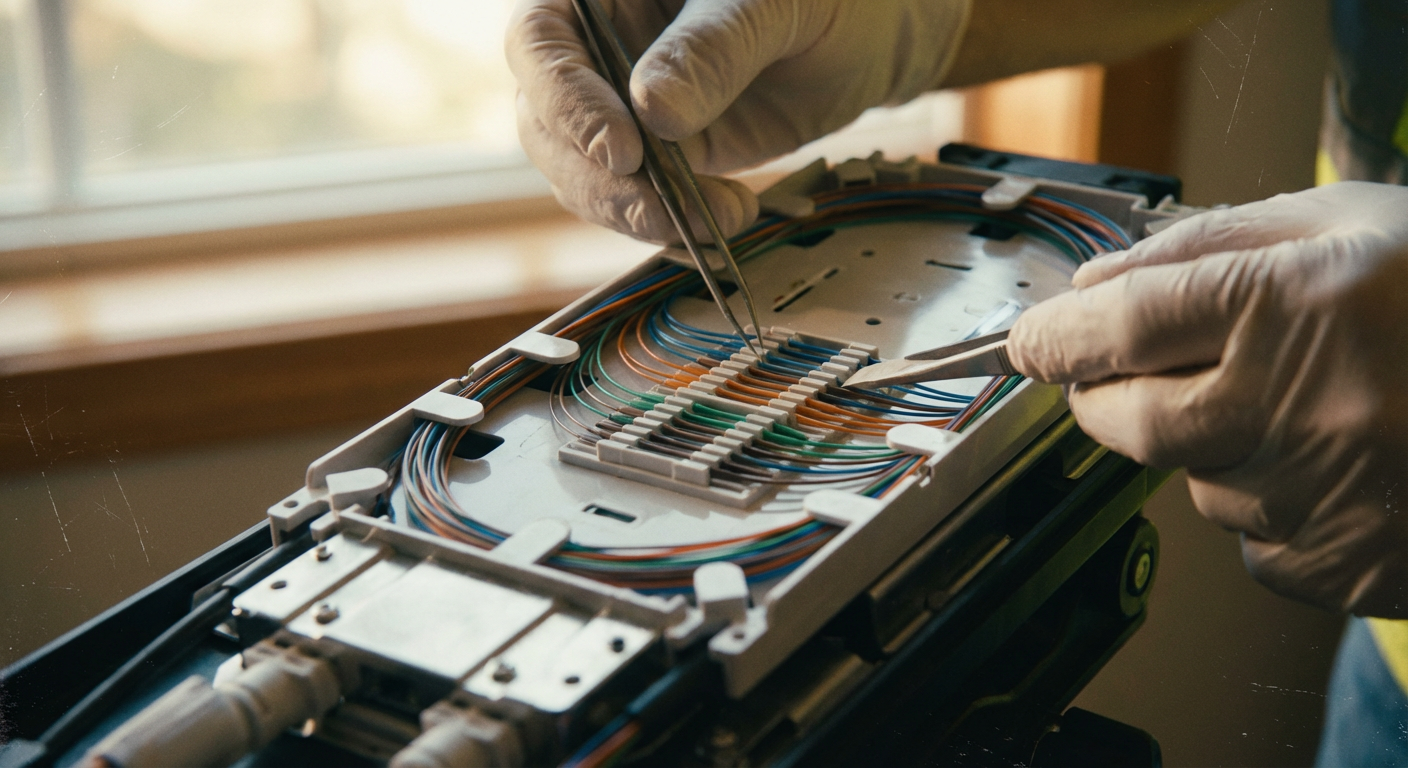
A clean splice tray is the mark of a skilled fiber technician
$59,265
Average Annual Starting Salary
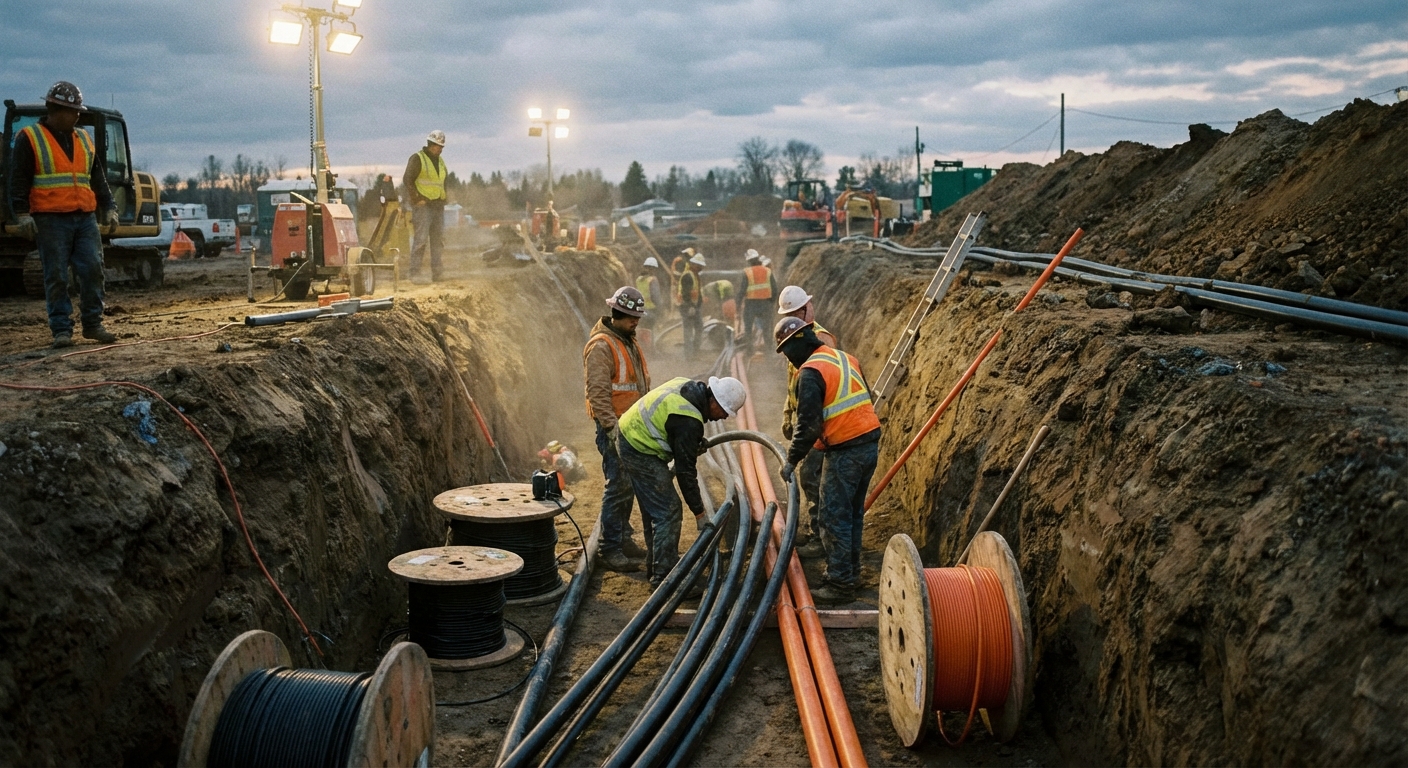
Underground fiber pulls connect campuses and data centers across miles
$100,000+
Experienced Technician Ceiling
$28-$35
Typical Hourly Rate
30,000
Technicians Needed Immediately
36x
More Fiber Per AI Rack vs Traditional
$42.5B
BEAD Program Federal Funding
The Fastest Entry Path in This Entire Course
Here is the thing that makes fiber optics especially compelling for people considering a career transition: you can be working in this field, earning good money, in as little as one to six months. That is not a promise or an exaggeration. That is the realistic timeline for someone who commits to the certification process and pursues it with focus.
The fiber optic industry has well-established, widely recognized certifications that employers genuinely value and that can be earned through concentrated short-term programs. You do not need a five-year apprenticeship or a two-year degree to get your foot in the door. You need the right certifications, some hands-on practice, and the willingness to start at the entry level of a field with a clear upward trajectory.
Two certifications form the core of the fiber optic credential pathway. The FOA CFOT (Certified Fiber Optic Technician) from the Fiber Optic Association takes 3 to 4 days of instruction and costs between $1,300 and $1,695. The BICSI Installer 2 certification takes 4.5 days and costs between $2,445 and $2,820. Together, these two credentials, which you can earn in under two weeks of combined training time, represent the recognized foundation of a professional fiber optic career.
Your total investment to enter this field: approximately $3,000 to $8,000 and one to six months of focused effort. Compare that to a two-year degree at $35,000 or a five-year apprenticeship and the value proposition becomes obvious. This is the fastest, most affordable entry point in this entire course, and it leads directly into work that is in extraordinary demand.
Two Demand Drivers, One Skill Set
Fiber optic technicians right now are being pulled in two directions simultaneously. The AI infrastructure build-out at hyperscale data centers is creating urgent demand for technicians who can handle the precision, high-density fiber work that AI clusters require. At the same time, the $42.5 billion BEAD Program is funding fiber deployments to rural and underserved communities across the country, creating a parallel wave of demand for technicians who can do outside plant installation and splicing work. A technician who develops skills in both areas has exceptional job flexibility and can follow the work wherever demand is highest.
The AI Connection: Why Fiber Matters More Than Ever
To understand why AI has transformed fiber optic demand so dramatically, you need to understand how AI training actually works at the hardware level.
When training a large AI model, you are running computations across thousands of GPUs simultaneously. Each GPU needs to exchange gradient updates with every other GPU during the backpropagation phase of training. This collective communication, called an all-reduce operation in the machine learning world, requires that every GPU in the cluster communicate with every other GPU, constantly, at the highest possible bandwidth and lowest possible latency.
The interconnect fabric that enables this communication is built on fiber optics, specifically high-speed coherent optical transceivers running over carefully managed fiber infrastructure. A cluster of 1,000 GPUs might have tens of thousands of individual fiber connections, all of which need to be installed correctly, terminated properly, and tested to verify they meet the optical loss specifications that the equipment requires.
One broken connection, one improperly terminated splice, one dirty connector can take down an entire section of the cluster. When the hardware in that cluster is worth hundreds of millions of dollars and every hour of downtime has a very real cost in lost training time, the precision with which fiber work is done is not a minor quality concern. It is mission-critical. And that precision is exactly what a skilled, certified fiber optic technician provides.
The US also needs to double its total fiber route miles by 2029 to meet projected demand. The total fiber optic market is valued at $20 billion and growing. These are not niche numbers. This is infrastructure spending at a national scale, and every project needs technicians on the ground doing the actual installation and testing work.
Why One Bad Splice Can Cost Millions
In a properly designed fiber network, each splice or connector is allowed a certain amount of optical loss, measured in decibels. The loss budget for a link defines the maximum total loss from all connectors and splices combined while still maintaining reliable signal transmission. In high-density AI cluster interconnects, these budgets are tight. A splice that meets standards for a telephone company's outside plant installation might introduce too much loss for a 400G or 800G transceiver running inside an AI cluster. The technicians who understand loss budgets, fusion splice quality, and OTDR testing at this level of precision are the ones who get called back for the next project and the one after that.
How Your White-Collar Background Transfers
Fiber optic work rewards precision, documentation, and systematic thinking. All three of these qualities are developed and refined in white-collar careers, and all three translate directly into the kind of work that distinguishes an excellent fiber optic technician from an adequate one.
Software Engineers
You already understand networking at a level that most people entering the trades do not. You know what the fiber connects to. You understand why latency matters, why bandwidth matters, why redundancy matters. When you are running fiber for an AI cluster interconnect, you understand the architectural intent of the network and why each link needs to meet its specifications.
This contextual understanding makes you more than a cable-puller. It makes you someone who can have technical conversations with the network engineers designing the infrastructure and understand the implications of their requirements. Software engineers who move into fiber optic installation often find themselves moving into hybrid roles that blend hands-on work with technical coordination and even commissioning support. These roles pay at the higher end of the fiber technician range because they require skills that are genuinely rare.
Accountants and Finance Professionals
The precision mindset that makes a good accountant is exactly what fiber optic work demands. Loss budget calculations are applied mathematics: you are accounting for every source of optical loss in a link and verifying that the total does not exceed the budget. OTDR (Optical Time Domain Reflectometer) trace analysis requires careful reading of measurement data, identifying anomalies, and documenting findings in a format that other technicians can understand and act on.
Documentation quality in fiber optic work is something that separates professionals from amateurs. A properly documented fiber installation includes splice records, OTDR traces for every fiber, as-built drawings showing cable routes and splice locations, and a complete chain-of-custody for all testing results. This is essentially an audit trail for a physical installation. Accountants and compliance professionals approach this kind of documentation as a matter of course. For many others, it is a discipline that has to be learned.
Operations Managers
Large fiber deployment projects, whether for broadband infrastructure or data center builds, involve complex logistics: coordinating crews, managing material deliveries, sequencing work to avoid conflicts with other trades, tracking progress against project milestones, and communicating status to general contractors and clients. These are operations management skills, and they are in short supply on fiber projects.
Experienced fiber technicians who can also manage project logistics are valuable candidates for lead technician and project foreman roles. Add your operations background to a solid technical foundation and you are describing someone who can both do the work and run the project. That combination commands compensation significantly above the technician baseline. Operations managers who transition to fiber often find that their career trajectory in the trade accelerates quickly once they have the technical credentials to go with their existing leadership skills.
Marketing and Tech-Savvy Professionals
Project coordination roles on fiber deployments are available to people who combine technical knowledge with strong organizational and communication skills. The BEAD Program broadband deployments in particular involve significant stakeholder coordination: municipal governments, utility companies, property owners, community organizations, and the telecom providers building the infrastructure. Someone who understands the technical work and can also communicate clearly with non-technical stakeholders is genuinely valuable to the organizations executing these projects.
Marketing professionals who develop fiber optic technical knowledge can also find roles at telecommunications equipment manufacturers, internet service providers, and fiber network operators in technical product management, technical marketing, and customer success positions that blend both skill sets. These hybrid roles are well-compensated precisely because the combination is uncommon.
Salary Reality: What the Market Actually Pays
Fiber optic technician compensation ranges more widely than some other skilled trades because the work itself spans from entry-level residential broadband installation to highly specialized data center and AI cluster work. Your goal should be to understand where in that range your skills and certifications position you, and to know the trajectory toward the higher end.
| Stage |
Typical Annual Earnings |
Notes |
| Entry Level (CFOT, First Job) |
$38,000 to $52,000 |
General fiber installation, residential and commercial |
| Journeyman Technician (2-4 Years) |
$59,265 to $72,282 |
Average range for experienced technicians |
| Data Center Specialist |
$72,000 to $90,000 |
Precision fiber, structured cabling in DC environments |
| Senior / AI Infrastructure Specialist |
$85,000 to $100,000+ |
High-speed interconnects, AI cluster fiber work |
| Project Lead / Foreman |
$95,000 to $130,000+ |
Large-scale deployments, team management |
The hourly rate for fiber optic technicians typically runs from $28 to $35 for experienced workers, with premium rates for specialized environments and after-hours emergency work. In high-demand markets like Northern Virginia (the most concentrated data center market in the world), San Jose, Phoenix, and Chicago, rates are consistently at the upper end of the range or above it.
Contract and 1099 work is common in this field, especially for technicians who develop specialized expertise. Independent contractors with proven skills in data center fiber and AI cluster installation can command rates significantly above what full-time employment offers, trading benefits for higher gross income and flexibility in where and when they work.
The BEAD Program: A Second Engine of Demand
The $42.5 billion Broadband Equity, Access, and Deployment (BEAD) Program is one of the largest infrastructure investments in US history. It is funding fiber deployment to rural communities that have never had high-speed internet access. This work is largely happening through subcontractors who need certified fiber optic technicians for both the installation and the testing and acceptance phases. For someone who lives in or near a rural area, this program is creating local job opportunities that will persist for years. For someone who wants to work across different environments, it provides an alternative demand source when data center project work has gaps. Both demand drivers are real, both are large, and both are pulling from the same pool of certified technicians.
Training Paths: What You Actually Need to Learn
Fiber optic work has a combination of foundational theory and hands-on physical skill. The theory covers optical physics (how light behaves in glass fiber), fiber types and specifications, connector types, splicing methods, test equipment operation, and loss budget calculations. The hands-on skills involve fiber handling, connector termination (polishing and epoxy methods as well as pre-polished field-installable connectors), fusion splicing, OTDR operation and trace analysis, and cable management in structured cabling environments.
The FOA CFOT Certification
The Fiber Optic Association Certified Fiber Optic Technician (CFOT) credential is the most widely recognized entry-level certification in the fiber optic industry. The exam covers optical fiber, cables, connectors, splicing, testing, and system design. To earn the certification, you need either to complete an approved FOA training program or to pass the exam with sufficient hands-on experience documentation.
FOA-approved training programs run 3 to 4 days and cost between $1,300 and $1,695. These intensive programs cover both the theory and the hands-on skills, giving you time on actual fiber equipment under the guidance of an experienced instructor. By the end, you are performing fusion splices, terminating connectors, running OTDR tests, and calculating loss budgets. This is a lot to absorb in a few days, but for someone with a technical background who can study effectively, it is very achievable.
BICSI Installer 2 Certification
BICSI (Building Industry Consulting Service International) is the professional organization for information and communications technology (ICT) infrastructure professionals. Their Installer 2 certification covers both copper and fiber structured cabling systems at a more advanced level than the CFOT alone. The 4.5-day program and exam covers copper systems as well as fiber, making it a broader credential.
BICSI certification is particularly valued by structured cabling contractors working on commercial and data center projects, where the full scope of cabling work includes both fiber and copper. Adding BICSI to your CFOT gives you a more complete credential set and makes you competitive for a wider range of projects and employers.
BICSI RCDD: The Premium Credential
For those who want to advance into design and project management roles, the BICSI Registered Communications Distribution Designer (RCDD) is the gold-standard credential for network infrastructure design. This is a more advanced credential that requires passing a comprehensive exam covering structured cabling design, telecommunications infrastructure standards, and related technical knowledge. RCDDs typically work in design and consulting roles rather than hands-on installation, and the compensation reflects the seniority of the credential.
Additional Certifications Worth Pursuing
Beyond the core credentials, several additional certifications add value for fiber optic technicians working in data center environments. Manufacturer-specific certifications from companies like CommScope, Panduit, Corning, and Belden are recognized by large-scale structured cabling contractors and some data center operators. OSHA 10 and OSHA 30 are required or preferred by most contractors. And as you develop experience with specific equipment, vendor training programs keep your skills current with evolving technology.
Hands-On Practice Before Your Exam
The most important thing you can do before your FOA CFOT exam is get hands-on time with actual fiber. Fusion splicers and OTDR units are available for rent from some training providers and can be borrowed from technical colleges that offer HVAC or telecom programs. Even just purchasing an inexpensive practice kit with fiber, connectors, and a basic polishing kit gives you the manual dexterity foundation that the exam and your first job will require. Fiber handling is a physical skill. Reading about it is useful. Doing it is what builds the competence that certification validates.
A Day in the Life: Precision Work at the Speed of Light
Fiber optic technician work varies significantly based on whether you are doing inside plant work (data centers and buildings), outside plant work (aerial and underground cable), or specialty work on AI cluster interconnects. Let's walk through a day on a data center fiber project, which represents the highest-value and most interesting end of the spectrum.
7:00 AM
Project Briefing and Material Check
The morning starts with a review of the day's work scope with the project lead. You are working on the structured cabling for a new AI compute area: high-density multimode fiber for the cluster interconnects and single-mode fiber for the uplinks to the core network. You review the cable schedule to understand which panels, which ports, and which cable routes are on today's list. Materials are verified against the schedule to confirm you have the right cable types, connector types, and quantities staged for the work area.
8:00 AM
Cable Routing and Pathway Work
Cable routing in a data center requires careful planning and execution. Fiber cables are more fragile than copper and have minimum bend radius requirements that must be respected. You are working in the overhead cable tray, routing 144-count fiber trunk cables from the main distribution area to the intermediate distribution frames nearest the AI racks. This involves measuring runs carefully, cutting pathways cleanly, and managing the cables so that they lay properly without sharp bends or pinch points. It is methodical, physical work that rewards patience and attention to detail.
10:30 AM
Fusion Splicing
Some of the runs today require fusion splices to connect factory-terminated trunk cables to custom-length pigtails at the panel end. Fusion splicing is the work that most technicians find most satisfying: it requires clean preparation, precise cleaving of the fiber end, and careful alignment before the splicer arc-welds the two fiber ends together. A good splice adds as little as 0.02 dB of optical loss. A bad splice can add 0.5 dB or more. You see the loss value immediately on the splicer's display, and when you see that 0.02 dB result appear, the satisfaction is real and immediate. Every splice is a small test of your skill and technique.
1:00 PM
OTDR Testing and Documentation
After lunch, you shift to testing the runs that were completed in the morning. The OTDR (Optical Time Domain Reflectometer) is your primary testing tool: it sends a pulse of light down the fiber and measures the return signal as a function of time, producing a trace that shows every splice, connector, and any anomalies in the fiber path. You run bidirectional OTDR tests on each fiber, compare the results to the loss budget calculations, and flag any fibers that are outside specification for investigation and correction. All results get documented in the testing log that will become part of the project's permanent records.
3:00 PM
Troubleshooting a High-Loss Fiber
One of the test results shows higher-than-expected loss on a single fiber in a 12-fiber trunk. The OTDR trace shows the anomaly is located about 23 meters from the far end, consistent with a mechanical damage point in the cable routing. You re-inspect that section of the cable run and find a small kink where the cable passes through a cable tray edge without proper protection. The fix is to add a protective sleeve and re-route the cable slightly to eliminate the kink. After the correction, you re-test and confirm the loss is now within specification. Finding and fixing that single fiber took 45 minutes. Leaving it would have meant a network failure during the first AI training run, potentially costing far more than the entire cable installation.
4:30 PM
Coordination with Network Engineers
At the end of the day, you connect with the network engineering team to review testing results and plan the next day's sequence. They have questions about the routing of some long-distance uplink fibers and want to discuss options for a cable path that avoids a section of the floor that another contractor will be working in tomorrow. You pull up the cable schedule and as-built drawings and work through the sequencing options with them. This kind of coordination is a natural part of large project work, and your ability to have a technical conversation at their level makes it faster and more effective for everyone.
The Physical and Technical Reality of Fiber Work
Fiber optic work is less physically demanding than some trades (no heavy lifting of equipment, no high-voltage hazards) but it requires a combination of manual dexterity, physical endurance, and focused attention that should not be underestimated.
You will spend significant time working in overhead spaces, in tight cable tray environments, and sometimes on elevated work platforms. You will be on your feet for most of the day. Fusion splicing requires steady hands and the ability to see well, since the work involves handling glass fiber that is thinner than a human hair. Good near vision (with correction if needed) is important for fiber termination and splicing work.
The focused, precision aspect of fiber work is something that many white-collar professionals find genuinely engaging. It is a craft where your technique directly determines the quality of your output, and where improvement is measurable in the numbers your test equipment produces. The feeling of running a perfect splice and seeing the 0.02 dB loss value appear on your splicer display is a direct feedback loop that many people find deeply satisfying in a way that producing another PowerPoint presentation never was.
Data center environments are generally clean, climate-controlled, and well-lit. Outside plant work (aerial and underground cable) involves working outdoors in all weather conditions and sometimes in more physically demanding situations: bucket trucks, trenching, working in hand holes and manholes. Both environments have their appeal depending on your personal preferences. Many technicians who start in data center work eventually take on outside plant projects for variety, or focus exclusively on data centers for the environment and compensation premium.
The Detail That Separates Great Technicians
Cleanliness is the variable that most significantly affects fiber optic performance that new technicians underestimate. A microscopic particle of dust on a fiber connector face can block or scatter light in a way that looks identical to a poorly made connection. Every connector end-face should be inspected with a fiber optic microscope before mating. Every connector should be cleaned with appropriate fiber optic cleaning tools before inspection. This discipline seems minor until you spend two hours troubleshooting a bad link only to discover a dirty connector that a 30-second cleaning would have prevented. The technicians who build the habit of inspection and cleaning from day one are the ones who develop a reputation for reliable, first-time quality work.
Career Paths: Where Fiber Takes You
Fiber optic expertise is a platform that supports multiple career directions. The hands-on technical path leads from technician to lead technician to field supervisor, with compensation rising at each step as experience and credentials accumulate. In high-demand markets and specialized environments like AI data centers, experienced lead technicians and project foremen earn well into six figures.
The design and engineering path leads through BICSI RCDD and similar credentials into structured cabling design, telecommunications consulting, and network infrastructure planning. These roles typically involve less hands-on work and more design and project management responsibility, with compensation that reflects the level of expertise and judgment required.
The contractor and entrepreneurship path is accessible relatively quickly in fiber optics compared to some other trades. A small structured cabling or fiber optic contracting business serving local commercial and data center clients can be started with modest equipment investment by someone with certifications, experience, and the business skills that many white-collar professionals already have. Structured cabling contractors typically work on project-based contracts with healthy margins on data center work.
The technology transition path applies to software engineers and network professionals who develop fiber optic skills: moving into optical networking roles, network operations center (NOC) positions that span both the physical fiber layer and the logical network, or technical product management at optical networking companies. These roles leverage the combination of fiber technical knowledge and networking or software background in ways that few candidates can offer.
Your Action Plan: The Fastest Path to Working in This Field
-
Find an FOA-approved CFOT training provider near you. Go to thefoa.org and use their training provider directory to find an approved program in your area. Programs run 3 to 4 days. If there is not a convenient local option, several providers offer training in multiple cities on a rotating schedule. Register for the earliest available session that works for your calendar. This one step moves you from "interested" to "in progress" and that momentum matters.
-
Begin studying before the course starts. The FOA has free study materials available on their website. Start reading the CFOT preparation guide now. Understanding optical fiber basics, fiber types, and connector types before your training begins means you will absorb the hands-on instruction more effectively and have more mental bandwidth for the physical skills practice. The people who prepare in advance consistently do better in the intensive training environment.
-
Get your hands on fiber before training if possible. Some local tool rental companies, community colleges, and vocational programs have fiber optic practice equipment available. Even a basic inspection of a fiber connector end-face under a loupe, or watching someone perform a fusion splice in person, gives you context that makes the training more concrete. YouTube channels from fiber technicians and FOA instructors show real splicing and testing work that is worth watching before you arrive at your first training session.
-
Research the data center market in your area. The Northern Virginia (NOVA) corridor, Phoenix, Chicago, Dallas, and Atlanta are among the highest-concentration data center markets in the US, with intense, ongoing demand for fiber technicians. If you are near one of these markets, you have exceptional job prospects immediately after certification. If you are in a smaller market, identify the local and regional contractors doing data center structured cabling work in your area: these are the companies to target for your first job.
-
Identify BEAD Program projects in your state. Every state has a Broadband Office managing BEAD Program implementation. Most state broadband offices have public websites showing where funding is going, which ISPs are building infrastructure, and on what timeline. These projects need certified technicians, and they are happening in every state. If you want to understand the full scope of demand in your geographic area, tracking BEAD projects gives you a clear picture of where the work is heading.
-
Connect with the structured cabling and fiber professional community. BICSI has local chapters in most major cities that host meetings, technical presentations, and networking events. BICSI chapter meetings are an excellent way to meet the contractors and engineers who hire fiber technicians, understand what the local market is looking for, and build relationships before you are actively job searching. The fiber optic professional community is generally welcoming to people who are clearly serious about learning the trade.
-
Plan your certification roadmap beyond the CFOT. Once you have your CFOT, the next step is the BICSI Installer 2. After that, consider what specialization makes sense given your target market: data center structured cabling, outside plant fiber for BEAD projects, or the RCDD credential if you want to move toward design roles. Having a clear credential roadmap before you start helps you make decisions about continuing education that align with where you want to go, not just what is convenient at the time.
The Bottom Line
Fiber optic technician is, in practical terms, the most accessible entry point in this entire course. The certification timeline is weeks, not years. The initial investment is thousands of dollars, not tens of thousands. And the demand is immediate, documented, and growing faster than the supply of qualified technicians can keep up with.
The AI economy is built on physical infrastructure. Electrical power, thermal management, and fiber optic connectivity are the three pillars that make AI possible at scale. You have now seen all three in these first modules. Each one has a compelling case. Fiber combines the fastest entry timeline with genuine long-term demand and a clear career trajectory that rewards the skills and habits you have already developed in white-collar work.
One thing is worth repeating: the people who are going to look back in five years and feel good about where they landed are the ones who make a decision now and start moving. Not eventually. Now. The demand that exists today will attract more people over time, and the advantage of being early in a rapidly growing field is real.
Module 4 continues the journey through the physical trades that power the AI economy. Keep going. The picture keeps getting better.